The village of Parkdale

An enthusiastic visitor to Parkdale in a letter to The Parkdale Register in 1881 stated "The place is not subject to malarial influences and is uncommonly healthy... The climate is tempered by the breezes of Lake Ontario, which dispense a refreshing coolness lacking in the close and sultry city...".

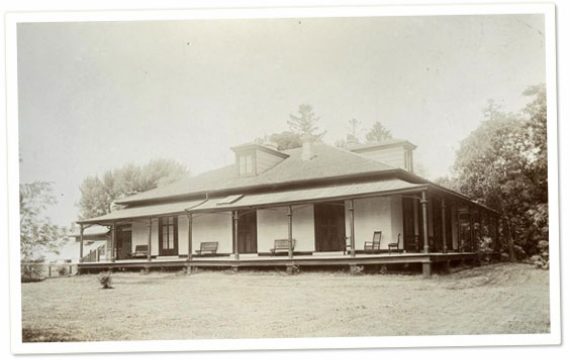
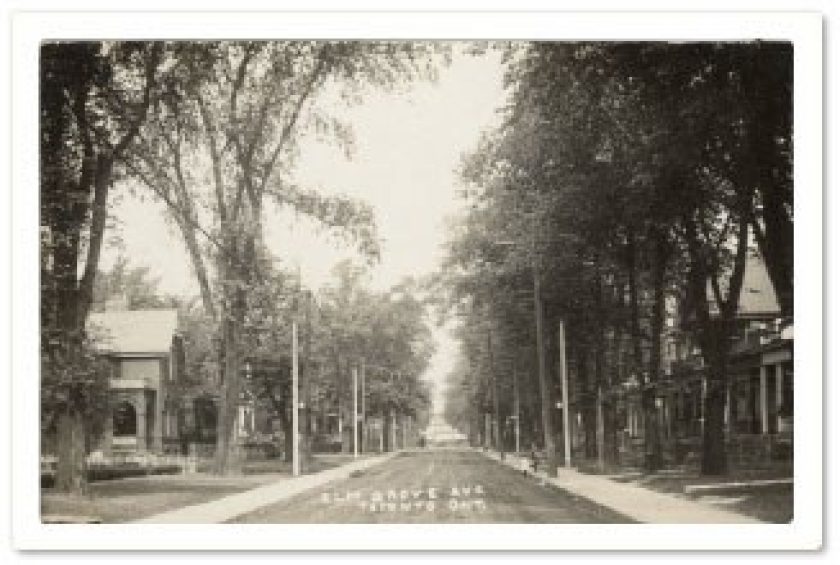
The flavour of the area originally was distinctively upper middle class. Its substantial houses were designed and built for businessmen who were the entrepreneurs of the 1880's. They saw Parkdale as a desirable rural environment, sufficiently removed from the dirty and polluted conditions of late Victorian Toronto - the same conditions that led to the growth of other prime residential neighbourhoods such as Rosedale.

The names of Parkdale's streets themselves commemorate the solid citizens of the area: Jameson, an Attorney General of Upper Canada (Jameson's wife, Anna, who joined him from England, was to write a series of letters back to England which became a Canadian classic book on the times entitled "Letters form Upper Canada". And... speaking of books... Mazo de la Roche, author of the "Jalna" series of books, spent her childhood on Dunn Avenue in Parkdale and much of her description of times and scenes were believed to be based on her Parkdale experiences.) Laxton Street in the area was named for an early Alderman and member of the Board of Education, likewise Mr. Beaty was a mayor of Toronto. Dunn, after whom Dunn Avenue was named, was the son of the Receiver General of Upper Canada from 1820 to 1843.In the early 1900's Parkdale was still an exclusive residential area; however as the population increased and Toronto extended westwards it lost its distinctive character.

In 1921 the Sunnyside Leisure and Amusement complex opened and until 1956 when it was closed, was a popular spot for bathing and boardwalking. The sole existing relics of this area are the Sunnyside Bathing Pavilion and the still-popular Palais Royale. In 1956 the Gardiner Expressway was built, cutting off the lake from South Parkdale, and closing a chapter of the area's history.

More recently, adsentee owners have converted many of the grand old houses into illegal "rooms" and "Bachelorettes". The development has been protested vigorously by concerned residents but is receiving less than sympathetic attention from city planners and others responsible for enforcement of by-laws.

Currently Parkdale is again undergoing change. A downtown life-style trend has brought new people into the area. Attracted by the excellent stock of 1880's housing, they have renovated and restored many of these historic properties and have once again brought a sense of community to the Village of Parkdale. It is this sense of community that we are demonstrating by inviting you to join us in "The First Annual Tour of the Historic Houses of Parkdale." We are indebted to the Architectural Conservancy Toronto for assistance in preparing this material.

The neighbourhood of Parkdale is bounded by Bloor Street West to the north, the C.N. and C.P. railway lines and Dufferin Street to the east, Lake Ontario to the south, and Roncesvalles Avenue to the west.

Historically, Parkdale has been a place to which people sought to come - as opposed to a place that just happened to evolve because of urban sprawl. This attraction is evidenced long before Parkdale received its name. Archaeological excavations at the Canadian National Exhibition (C.N.E.) grounds unearthed a Late Archaic encampment of indigenous peoples from 3,000 years ago. Although destruction of archaeological sites in the urban area have made for impoverished data, the land was considered to be continuously occupied by ancestors of the Huron and Neutrals (pre-1649), the Seneca (until 1687), and the Mississauga's.

Fort Rouille

The French built Fort Rouille in 1750 as a trading post (where the remains of the Late Archaic encampment were found), on top of a steep clay bank rising from the narrow beach on the lakefront, 40 metres east of present day Dufferin Street. Approximately 300 acres (half within the area now called Parkdale) surrounding the fort were cleared for food gardens and to discourage ambushes. As those who had settled before them, the site was likely chosen for its close proximity to the mouth of the Toronto harbour, and the vantage point it offered from the cliff of the bank. To the west, near present day Jane and Annette Streets, was the Seneca village of Teiaiagon ("The Crossing"), and at the mouth of Humber Bay, a Mississauga settlement. Fort Rouille was able to take advantage of First Nations fur traders as they made their way along the portage routes of the Great Lakes.

The pollen counts in soil samples taken during the 1982 archaeological excavations of Fort Rouille revealed that the poorly drained, mostly clay soils of the lands around the fort were covered in mixed conifer-hardwood forest which, in the locality, was dominated by white pine. Other species found were: hemlock, cedar, spruce, oak, basswood, maple, willow, and beech. Pollen from other vegetation included grasses, wildflowers of the Composite Family, and ragweed (though only one grain was found in one sample).

Animal remains at the site showed the presence of cow, dog, white-tailed deer, chicken, black bear, wolverine, turkey, and wall-eyed bass.

The fort apparently was successful, both as a fur trade post and as a recruitment centre for attacks against the British. Trade was especially brisk for the post between 1754 and 1758, with Fort Rouille doing almost twice the business of other forts on the Great Lakes. However, after the fall of Fort Niagara to the British on July 25, 1759, the French burnt and abandoned Fort Rouille, having destroyed any items of use.

Division of Land

In 1787, the British purchased the Toronto region from the Mississauga's and proceeded, in 1793, to survey lots now in Parkdale. Many of these 100 to 200 acre park lots were granted to British military and political officials. By 1851m three-quarters of Parkdale was under cultivation. The main roads were Bloor Street, Queen Street (then called Lot Street), Dundas Street, and Lake Shore Road. However, an 1868 military sketch of the west end of York Township, indicated the present Parkdale area to be, for the most part, uninhabited. Dufferin Street was not open below Dundas Street, likely because of the presence of wetlands. Brockton Road was used as the main north-south through-fare.

Owing to the deaths of three major property owners in the 1870's, large tracts of land were subdivided and placed on the open market, thus paving the way for the formation of a new community. It was at this time, that many of the Parkdale streets south of Queen, were laid out.

Parkdale Village

The Toronto House Building Association was the first company to actively promote and develop real estate in Parkdale and it was likely that they gave the area its name. It was often referred to as 'The Flowery Suburb' and "The Parkdale Register" said it had "the diversified scenery of an undulating expanse of fertile country, wooded, watered, cultivated, and adorned with attractive homes". There was a creek that ran up to Queen between Cowan and Dunn; a pond at the middle of Maple Grove; and Mead's Hill, crowned with lilac bushes was lined with pine trees rolling from Triller to Roncesvalles Avenue. By the mid-1870's Parkdale was firmly established as a lakeside community and estates in South Parkdale (ie. South of Queen Street) were much sought after by the wealthy British class of Toronto, wishing to escape the city - it's factories, high property taxes, and poor drinking and swimming water. (Raw sewage continued to be empted into Toronto Harbour until the 1890's) North Parkdale (ie. north of Queen) was becoming the home of the working class: labourers and recent immigrants from Ireland, Scotland, and England, attracted by the lower property taxes and good access to public transportation to Toronto.

In 1879, Parkdale became incorporated as a village. It was, however, not without some controversy surrounding it. One issue for Torontonians, expressed in The Globe, was a fear that the development of the Village of Parkdale would cut citizens' access to High Park, which had recently been donated to the City of Toronto by John G. Howard. At the time, the Great West Railway was running daily excursions to the Park. It proved to be a groundless fear.

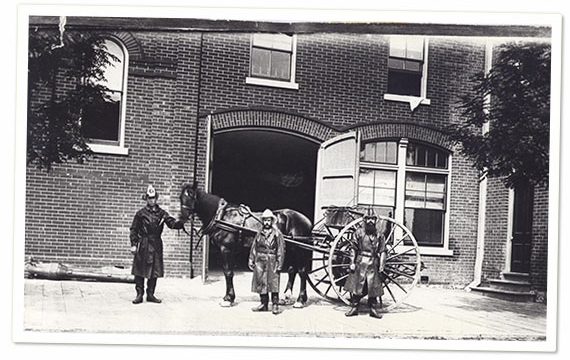
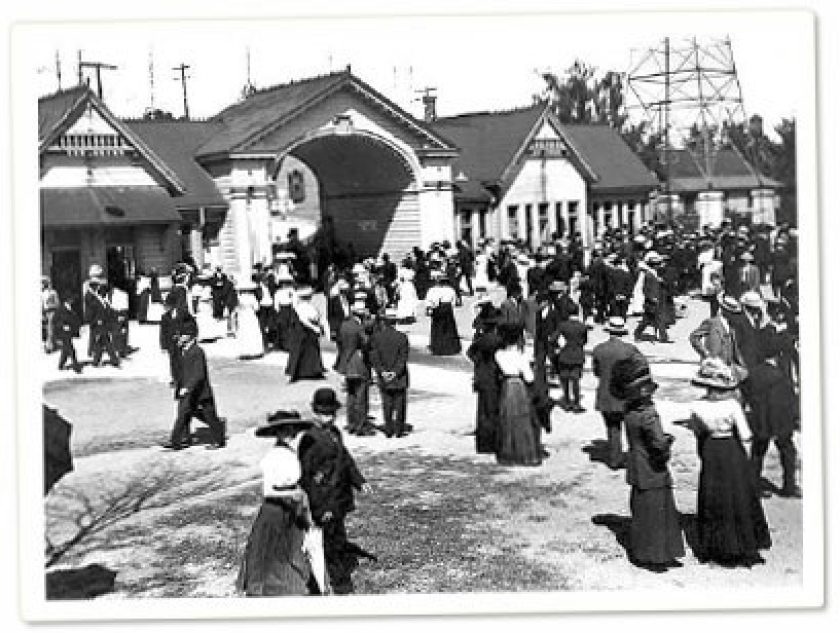
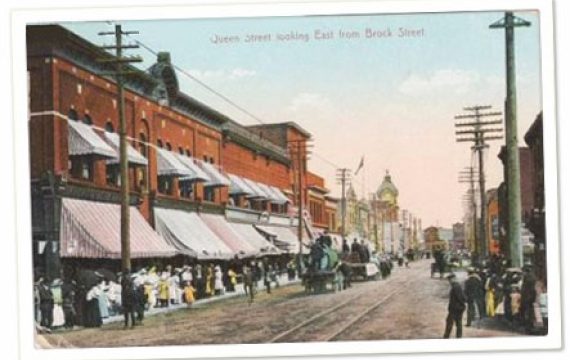
Within a year, Parkdale had the beginning of a sewer system, a railway station, a fire hall, a constabulary, as well as its two thriving newspapers, gas street lighting, two general stores (one with a post office), two butchers, a grocery store, blacksmith and wagon builder, telegraph operator, cabinet maker, public school, Methodist church, and toll-gate. It had a strong local government and developed its own civic buildings. Queen Street was the site of most of the commercial and civic development. Later, by the 1920's, after Jewish, Chinese, and Italian immigrants settled there, the business district expanded northward, up the east side of Roncesvalles. It became a settlement area for many newcomers afterwards and was nicknamed "the 50 cent side", whereas the west side was "the $1 side".

Intent upon maintaining its image of beauty and pleasantness, the Village Council fostered horticultural activities, such as public tree planting, and enacted protectionist laws, such as, making it illegal to cause intentional injury to any tree in the village, and stringently enforced the by-law against allowing dogs, cattle and hogs to run at large.

In 1886, with a population of over 2,000, Parkdale changed its status from village to town. The new Town Council had sixteen officials and six standing committees: finance, works, waterworks, fire, gas, police, board of health, and property. Apparently the town's bureaucracy grew as well for the Parkdale Times commented on 16 September 1887 that "Parkdale has more officials than any town and many small cities in the province of Ontario".
Inauguration as a town enabled Parkdale to expand its boundaries to include the waterworks system on the lakeshore, just west of Roncesvalles Avenue. A breakwater and cribwork were constructed along the shoreline of Parkdale to help protect properties against continual erosion.

Within two years, Parkdale's population had more than doubled, it was in debt, and Toronto had annexed land all around the town. Pressure was mounting to annex Parkdale. Debate was heated and raucous. In the end, after almost ten years of independent governance, Parkdale citizens voted for annexation to Toronto.

Transportation

Traveling Parkdale's streets in the early years was problematic because the heavy clay soil wreaked havoc with horse and wagon, especially in the spring, and after a rainfall. In 1884, the town began paving the streets with cedar blocks. However, Queen Street was brickpaved by 1886 in order to accommodate the horse-drawn Toronto Street Railway cars.

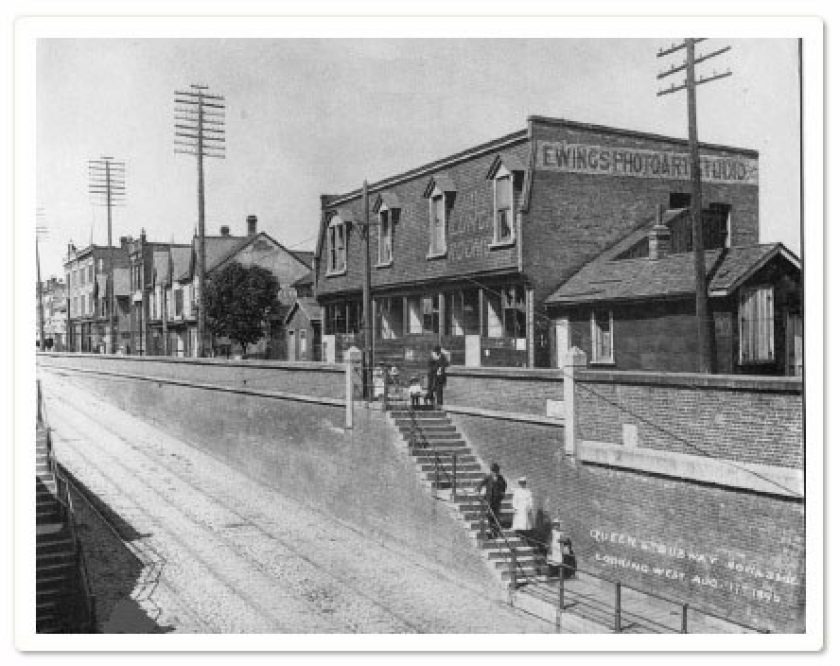
Railway transit was very popular. At one point Parkdale had five train lines passing through its boundaries. With increased traffic came the concern for public safety at level crossings - particularly at Queen and Dufferin Streets. The building of a subway tunnel for pedestrian and vehicular traffic, beneath the railway tracks was marred with controversy. The project was debt-laden and accompanied by damage claims laid by residents who felt their property values declined. Another tunnel was built on King Street, east of Dufferin, as a joint venture with Toronto. The City of Toronto absorbed that debt from Parkdale when it was annexed in 1888.

In the early 1880's, Parkdale also offered water transportation by steamer from a wharf built at the foot of Dufferin Street. Back then, return fare between the Yonge Street and Parkdale wharf was only seven cents.

Social Life

In its early years, Parkdale's five churches - Anglican, Baptist, Methodist, Presbyterian, and Roman Catholic - provided the focus for social life. The churches were well-funded, owing to the wealthy makeup of the community, and each had many societies, clubs and organizations. There were Ladies' Auxiliaries, Girl Guides, Boy Scouts, choirs, country picnics, orchestras, recitals and concerts, tea-parties and theological ectures. The churches were also involved with several institutions in the area: the Sacred Heart Orphanage, operated by the Sister's of St. Joseph, (and which is now St. Joseph's Health Centre); the Magdalene Asylum; the Home for the Incurables (now Queen Victoria Hospital); the Monastery of Our Lady of Charity - a home for wayward girls; and the Provincial Lunatic Asylum.


There were also many active secular organizations: the Village Improvement Society - promoted horticultural activities, sponsored lectures and concerts and offered elocution and music lessons; the Parkdale Library Association and Mechanics' Institute - established the public library; fraternal organizations; the Women's Christian Temperance Union; labour organizations - the Parkdale Knights of Labour and Librarian Trades and Labour Council, the Workingmen's Political Association; and a branch of the Young Men's Christian Association. There were also many sports-related clubs: lacrosse, cricket, baseball, croquet, lawn bowling, skating, and boating.

Every summer, the Industrial Association of Toronto (the forerunner to the Canadian National Exhibition) sponsored a large fair which showcased agricultural, horticultural, art and manufacturing activities. It was held at Exhibition Place - the only public parkland near Parkdale, other than an acre and a half plot purchased on the lakeshore.

In 1922, Sunnyside Amusement Park opened on 15 acres of lakefront near Parkside Drive. It was modeled after the American Coney Island, and had a Sea Serpent, twelve rides, fourteen game concessions, and five hot-dog stands. In 1925 the Sunnyside pool opened with capacity for 200 swimmers. There was also a Pavilion with two dining-rooms, two tea-gardens, and a dance floor. It was the summer resort for those who could not afford the journey north to Muskoka. Parkdalians thronged to Sunnyside, to take in the amusements, the vaudeville shows, and the spectacles, such as the boat burnings - and to walk along the Boardwalk.

The 1940's

With the advent of the Second World War and a depressed economy, there was unemployment, and many were forced to move from their homes. Hugh mansions that had been held in wealthy families for generations, could no longer be maintained and were sold. New landlords subdivided them into furnished flats and rooms for rent.

The 1950's

Although the Great Western and Grand Trunk Railways built lines in 1855 and 1856, which presented a barrier between the lakefront and Parkdale, the community's orientation - and drawing card - continued to be the lake, right up until the 1950's - when the Gardiner Expressway was built, limiting access to only town points of crossing. In 1951, City Council had approved the widening of Lakeshore Boulevard to six lanes from Dowling Avenue to Parkside Drive. Norman D. Wilson, a transportation engineer arguing against the route of the Gardiner stated: it's shore provided 'some of the most restful parkland in the Toronto area.'He pointed out that the expressway meant the destruction of homes south of the railway tracks, the complete elimination of all existing roadways there, and the - magnificent trees in South Parkdale'. It would completely sever the parkland from use by residents, since no means of access was indicated. In 1954, 170 houses were demolished. The expressway entirely eliminated many local streets. Parkdale had been dissected. It had been cut off from its focus.

With the advent of the novelty of television, attendance at Sunnyside had drastically fallen. After a series of three fires within three weeks, the Toronto Harbour Commission decided to demolish the giant roller coaster, and the merry-go-round was sold to Walt Disney. The Parkdale Pavilion was destroyed to make room for the expressway.

The 1960's

Once highway access to downtown Toronto was improved, it was inevitable that the population density would increase. A process of block-busting began on many streets, such as Jameson and Tyndall, that led to the wholesale destruction of single-family dwellings to make room for high-rise apartment complexes. The process of division of old homes that began in the 1940's accelerated.

The 1970's

In 1967, the Report on the Existing Housing Situation of South Parkdale was released. Because of its findings, lax zoning by-laws were changed, leaving many land speculators with properties which they could no longer demolish for high-rise construction. Their solution was to convert homes into as many single units as they could - very often illegally. These units were called bachelorettes. With the deinstitutionalization of the Queen Street Mental Hospital, these landlords found a ripe market for single people who often weren't aware of the housing codes, and their housing rights. However, tenants organized and lobbied the government, and by the late 70's, a freeze was put on bachelorette development.

The 80's and 90's

The previous two decades laid the groundwork for the present-day character of South Parkdale in particular, where 90% of residents are tenants. Parkdale has continued to be a place in which newcomers settle, though the reasons for doing so now, relate more to raw economics than they did a century ago. Parkdale is no longer an enclave of the wealthy. People are attracted by the good access to public transit, the close proximity to downtown Toronto, and shopping areas. Being close to High Park, Ontario Place, and the C.N.E., are assets as well. However, often the population is transient - as is evidenced by one local school's 80% turnover of students in one year. When this dynamic occurs, it can be difficult to build community.

Yet the Parkdale neighbourhood is strong, active, and vibrant. Its residents, as well as many who work in the area, are committed and passionate about nurturing the development, strength and capacity for a greater community vision and greater community health.

back to top

 
Fort Rouille


Fort Rouille Monument at the CNE


Town of Parkdale Corporate Seal


On Queen Street West Looking East at MacDonell 1905


King & Queen Postcard


King & Queen & Ronsesvalles 1912


Parkdale Methodist Church 1911


Queen Street West Subway


Parkdale Station


Bathing at Sunnyside 1917


Sunnyside Free Bathing 1907


Sunnyside Beach 1907